Available for pre-order now
Partial shipment upon request (please note in the order comments)
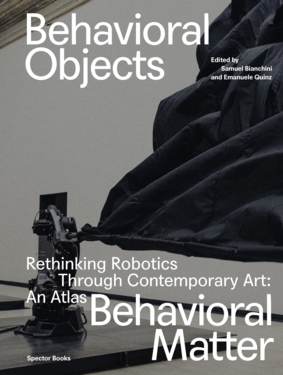
A choreography of black flags waved by a pair of robotic arms; objects that appear to breathe; architectural structures covered in scales that open and close; sliding walls that endlessly reconfigure the space in which they are exhibited. These objects pique our curiosity, compelling us to ask how they move and why. Yet this seemingly simple question prompts other, far more complex interrogations, given the growing importance of robots and other nonhuman agents, whether natural or artificial. What are we to make of these robotic artworks whose movements serve no useful purpose? How are they brought to life? What kind of relationships do they strike up with us humans?
This book seeks to answer such questions. It conducts a study of behavioral objects, in other words, autonomous robotic artworks capable of carrying out actions and reacting to external stimuli, while exhibiting lifelike behavior. Deploying specific mechanisms, active materials, dedicated software, or novel/alternative forms of artificial intelligence, these animated artworks seem to have a personality of their own that makes them appear more like subjects than objects. Troubling and uncanny, they question the frontiers between animate and inanimate, opening the way to a reflexive, even critical, approach to robotics.
The book includes eight essays, each written from the perspective of a different discipline, followed by 25 interviews with leading figures in the fields of philosophy, the arts, design, robotics, and materials science. At its core is a curated selection of 131 behavioral objects, both historical and contemporary. Conceived as an atlas, with maps and data visualizations, Behavioral Objects, Behavioral Matter offers a detailed comparative analysis of all aspects of these artworks.
More than just a new artistic genre, behavioral objects blur the boundaries between living and nonliving, forming an emerging species.
This book is edited by Samuel Bianchini and Emanuele Quinz, in collaboration with Rahma Khazam. Samuel Bianchini is an artist and teacher-researcher at École des Arts Décoratifs — PSL. Emanuele Quinz is an art and design historian and curator with a full professorship at Paris 8 University. Rahma Khazam is a philosopher affiliated with Institut ACTE at Paris 1 Panthéon-Sorbonne University.
With contributions by Emmanuel Alloa, Sofian Audry, James Auger, Joffrey Becker, Yoshua Bengio, Samuel Bianchini, Marie-Pier Boucher, Francesca Cozzolino, Lorraine Daston, Olivier Dauchot, Elie During, Delfina Fantini van Ditmar, María Fernández, Marinella Ferrara, Peter Fratzl, John Frazer, Paula Gaetano Adi, Petra Gemeinboeck, Ken Goldberg, Sophia Gräfe, Emmanuel Grimaud, Graham Harman, N. Katherine Hayles, Damith Herath, Tim Ingold, Jonas Jørgensen, Rahma Khazam, Sophie Krier, Yasuo Kuniyoshi, Ianis Lallemand, Cecilia Laschi, Jean-Paul Laumond, Rebecca Lemov, Dominique Lestel, Florent Levillain, Patrice Maniglier, Aurélie Mosse, Paul Pangaro, Simon Penny, Andrew Pickering, Alexandre Pitti, Emanuele Quinz, Mette Ramsgaard Thomsen, Patricia Ribault, Jessica Riskin, Rob Saunders, Isabelle Thomas-Fogiel, Skylar Tibbits, Elisabetta Zibetti.